How Much Protein Do You Need per Day? Chart by Body Weight
Find your daily protein target: 0.8 g/kg minimum, 1.2–1.6 g/kg if you lift. Chart by body weight, food list and a sample day of eating.

Most healthy adults need at least 0.8 grams of protein per kilogram of body weight per day (about 0.36 g per pound). If you do regular strength training or want to build muscle, the evidence supports roughly 1.2 to 1.6 g/kg (about 0.55–0.73 g per pound), and up to around 2 g/kg in some cases. For a 160-lb (73 kg) person, that’s about 58 g a day as a baseline and roughly 87–116 g if they lift. Below you’ll find a chart by body weight, protein counts for everyday foods, and how to spread it across your day.
One caveat up front: if you have kidney disease, diabetes with complications or any condition that calls for a special diet, your protein target should come from your doctor or a registered dietitian.
In this article
- What the evidence says about daily protein
- Protein chart by body weight
- How much protein is in everyday foods?
- A sample day with about 90 g of protein
- How to spread protein through the day
- Does the source of protein matter?
- Protein when you’re trying to lose weight
- 8 easy ways to add 10–20 g of protein
- Do I need protein powder?
- Can too much protein be harmful?
- The bottom line
- Keep reading
- Sources
What the evidence says about daily protein
The baseline for adults: 0.8 g/kg
The US National Academy of Medicine sets the Recommended Dietary Allowance at 0.8 g of protein per kilogram of body weight per day, as summarized by the Harvard T.H. Chan School of Public Health. Harvard puts it another way: just over 7 grams for every 20 pounds of body weight. That’s the amount that covers the basic needs of nearly all healthy people. It’s a floor to prevent deficiency, not an optimal target for everyone.
If you strength train: 1.2–1.6 g/kg (or a bit more)
A meta-analysis of 49 trials (Morton et al., British Journal of Sports Medicine, 2018) found that in people doing resistance training, extra protein modestly boosted gains in muscle and strength, and that beyond about 1.6 g/kg per day, there were no further gains in lean mass. The International Society of Sports Nutrition (ISSN) puts the sufficient range for most exercising people at 1.4–2.0 g/kg per day.
For beginners, the takeaway is simple: if you’re lifting two or three times a week, aiming for 1.2–1.6 g/kg is reasonable and usually easy to reach with ordinary food.
Over 65: at least 1.0–1.2 g/kg
Muscle is easier to lose as we age. The PROT-AGE expert group recommends that adults over 65 eat at least 1.0–1.2 g/kg per day, and 1.2 g/kg or more if they exercise. It flags one important exception: people with severe kidney disease who aren’t on dialysis may need to limit protein.
Protein chart by body weight
Rounded grams per day.
| Body weight | Baseline (0.8 g/kg) | Active or over 65 (1.2 g/kg) | Strength training (1.6 g/kg) |
|---|---|---|---|
| 120 lb (54 kg) | 44 g | 65 g | 87 g |
| 140 lb (64 kg) | 51 g | 76 g | 102 g |
| 160 lb (73 kg) | 58 g | 87 g | 116 g |
| 180 lb (82 kg) | 65 g | 98 g | 131 g |
| 200 lb (91 kg) | 73 g | 109 g | 145 g |
| 220 lb (100 kg) | 80 g | 120 g | 160 g |
Work out your own number
- Convert your weight to kilograms: pounds ÷ 2.2 (for example, 150 lb ÷ 2.2 ≈ 68 kg).
- Pick your multiplier: 0.8 if you’re mostly inactive; 1.2 if you’re active or over 65; 1.6 if you strength train regularly.
- Multiply: 68 × 1.2 = about 82 g a day.
If you’re carrying a lot of extra weight, using your total body weight can overestimate what you need. A practical workaround is to use a reference weight closer to a healthy range for you; a registered dietitian can help you fine-tune it.
How much protein is in everyday foods?
Approximate values; they vary by brand, variety and preparation.
| Food | Serving | Approx. protein |
|---|---|---|
| Chicken breast, cooked | 3.5 oz (100 g) | 31 g |
| Canned light tuna in water, drained | 1 small can (about 3.5 oz) | 25 g |
| Plain Greek yogurt | 6 oz (170 g) | 15–17 g |
| Firm tofu | 3.5 oz (100 g) | 12–17 g |
| Cooked lentils | 1 cup | 18 g |
| Cooked black beans | 1 cup | 15 g |
| Egg | 1 large | 6 g |
| Milk | 1 cup (8 fl oz) | 8 g |
| Cottage cheese | ½ cup | 12 g |
| Peanut butter | 2 tbsp | 7 g |
| Rolled oats | ½ cup dry (40 g) | 5 g |
A sample day with about 90 g of protein
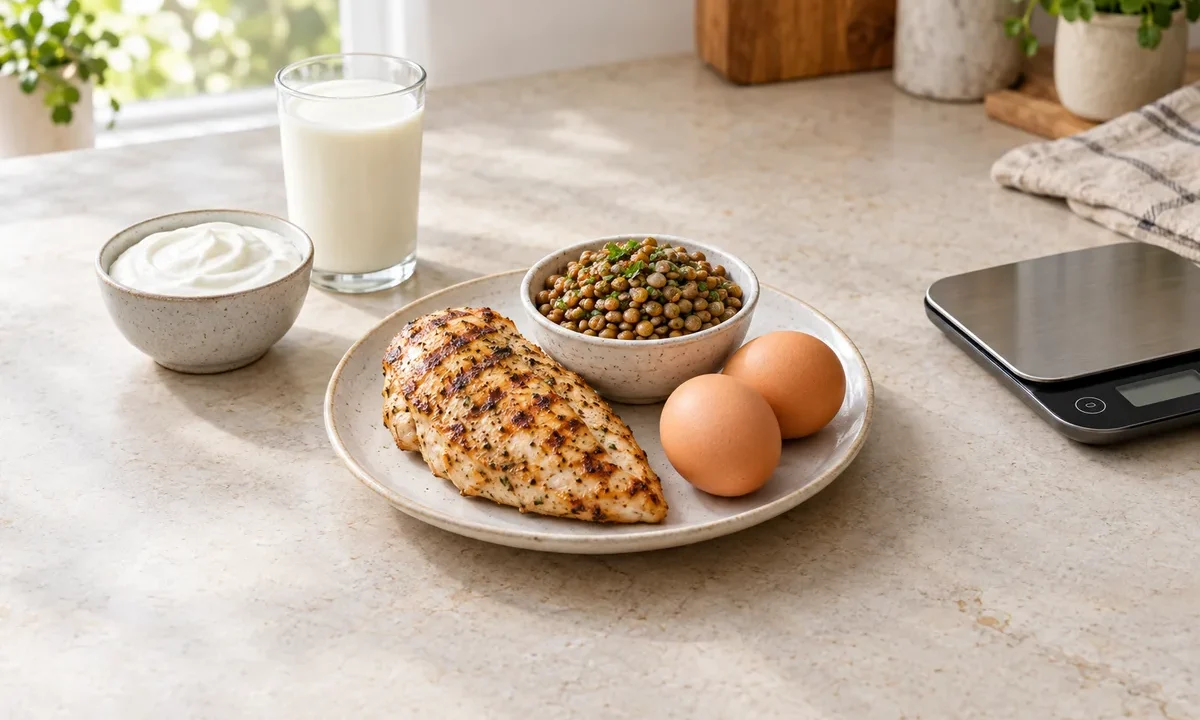
- Breakfast: 2 scrambled eggs with veggies + a glass of milk (about 20 g).
- Lunch: 4 oz grilled chicken with brown rice and salad (about 35 g).
- Snack: 6 oz Greek yogurt with fruit (about 16 g).
- Dinner: 1 cup lentil and vegetable stew (about 18 g).
Total: roughly 90 g, no supplements required. That comfortably covers the “active” range for someone weighing 150–165 lb.
How to spread protein through the day
The ISSN’s general guidance is servings of 20–40 g of high-quality protein spaced every 3–4 hours. You don’t need to be precise: the practical move is to include a protein source at every main meal instead of loading it all into dinner. If you work out, a protein-containing meal before or after your session is enough; there’s no strict “anabolic window” you have to race to hit.
Does the source of protein matter?
Yes. Harvard’s Nutrition Source notes that for long-term health, the protein “package” matters more than the amount. Swapping red and processed meat for beans, soy, nuts, fish or poultry is linked with lower cardiovascular risk. In practice:
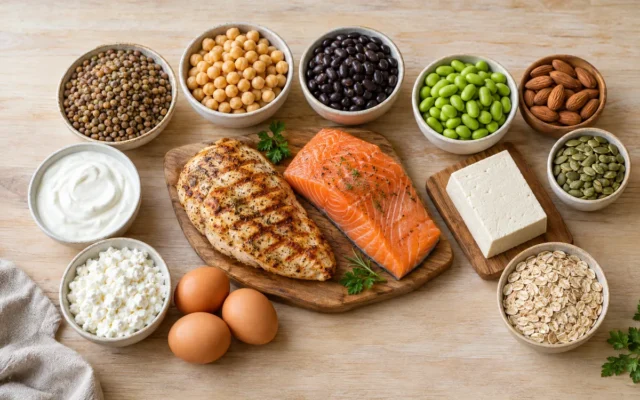
- Lean on beans and lentils, fish, eggs, dairy, poultry, tofu and nuts.
- Keep processed meats like bacon, deli meat and sausages as occasional foods.
- Vegetarian or vegan? Mix legumes, whole grains, soy and nuts over the day.
Protein when you’re trying to lose weight
When you eat fewer calories than you burn to lose fat, you also risk losing some muscle. Getting enough protein and doing strength training helps you hold on to it; the ISSN notes that even higher intakes may help resistance-trained people in a calorie deficit. For a beginner, aiming for the middle or upper part of the 1.2–1.6 g/kg range while losing weight is a sensible approach. Protein-rich meals also tend to be more filling, which can make eating a little less feel easier. If you have a lot of weight to lose or a health condition, it’s best to do this with professional support.
8 easy ways to add 10–20 g of protein
- Swap a sweetened yogurt for 6 oz of plain Greek yogurt.
- Add two eggs to breakfast.
- Toss half a cup of beans or lentils into soup or salad.
- Make your oatmeal with milk instead of water.
- Pack a small can of tuna for your lunch salad.
- Snack on cottage cheese with fruit.
- Add tofu or chickpeas to a vegetable stir-fry.
- Grab a handful of peanuts or almonds instead of cookies.
Do I need protein powder?
Usually not. Most people can meet their needs with food. Protein powder is simply a convenience if you struggle to hit your target because of a busy schedule or a plant-based diet. If you use it, choose brands with third-party testing, and don’t replace balanced meals with shakes.
Can too much protein be harmful?
For healthy people, intakes within the ranges above are considered safe in the research reviewed here. It’s a different story if you have chronic kidney disease: the US National Institute of Diabetes and Digestive and Kidney Diseases (NIDDK) explains that you may need to adjust how much protein you eat and recommends working with a dietitian or health care professional to find the right balance. If you have any concerns about your kidneys, check before increasing your intake.
The bottom line
- Baseline for healthy adults: 0.8 g/kg a day (about 0.36 g per pound).
- If you strength train: 1.2–1.6 g/kg is a practical, evidence-backed target.
- Over 65: at least 1.0–1.2 g/kg.
- Spread protein across 3–4 meals and favor quality sources.
- With kidney disease, always ask your doctor or dietitian first.
Keep reading
- To take it a step further, see a sample menu to eat 100 g of protein a day.
- You may also find useful how to use protein for weight loss.
Sources
- Harvard T.H. Chan School of Public Health. The Nutrition Source: Protein.
- Morton RW, et al. A systematic review, meta-analysis and meta-regression of the effect of protein supplementation on resistance training-induced gains in muscle mass and strength in healthy adults. British Journal of Sports Medicine, 2018.
- Jäger R, et al. International Society of Sports Nutrition Position Stand: protein and exercise. Journal of the International Society of Sports Nutrition, 2017.
- Bauer J, et al. Evidence-based recommendations for optimal dietary protein intake in older people: a position paper from the PROT-AGE Study Group. JAMDA, 2013.
- NIDDK. Healthy Eating for Adults with Chronic Kidney Disease.
- USDA. FoodData Central.
Frequently asked questions
How much protein do I need if I weigh 160 pounds?
About 58 g a day as a baseline (0.8 g/kg). If you're active, about 87 g (1.2 g/kg), and if you strength train regularly, up to about 116 g (1.6 g/kg).
Do I have to eat protein right after a workout?
No. Spreading protein over three or four meals, around 20–40 g each, matters more than precise timing. A protein-containing meal before or after training is plenty.
Can I get enough protein as a vegetarian?
Yes. Combining beans and lentils, soy and tofu, dairy or eggs (if you eat them), whole grains and nuts over the day can cover your needs. A registered dietitian can help you plan it.
Is a high-protein diet bad for your kidneys?
For healthy people, intakes in the recommended ranges are considered safe. If you have chronic kidney disease, your protein intake should be set with your doctor or a dietitian.
Nutrition values are approximate. This content is informational and does not replace advice from a dietitian or doctor, especially if you have kidney disease or another condition that requires a special diet.