How Long Does Meal Prep Last? Fridge and Freezer Chart, Labeling and Reheating
Cooked meal prep lasts 3–4 days in the fridge and 2–6 months in the freezer. Storage chart by food, labeling tips and safe reheating.

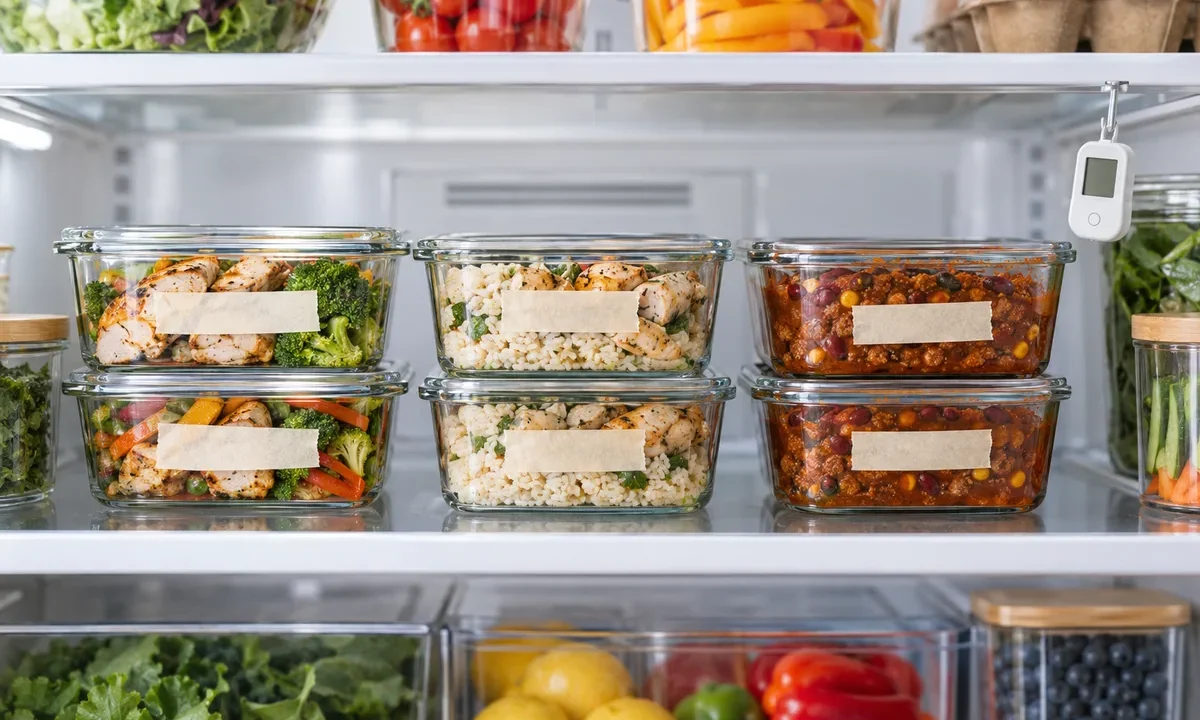
Most cooked meal prep lasts 3 to 4 days in the fridge at 40°F (4°C) or below, and 2 to 6 months in the freezer at 0°F (−18°C) before the quality starts to slip. That’s the guidance from FoodSafety.gov and the USDA. Below you’ll find a storage chart by type of food, a simple labeling system for your containers and the right way to thaw and reheat.
One thing that changes how you plan: day one is the day you cook. If you prep everything on Sunday, Wednesday is the last day those meals are safe to eat from the fridge. Thursday and Friday portions belong in the freezer, or in a second, smaller cook mid-week.
In this article
The two numbers to know
- Fridge: 40°F (4°C) or colder. Plenty of home fridges run warmer than that, especially in the door. An appliance thermometer costs a few dollars and settles the question.
- Freezer: 0°F (−18°C). At that temperature bacteria can’t grow, so frozen food stays safe indefinitely. The freezer times in the chart are about quality (flavor and texture), not safety.
Between 40°F and 140°F (4–60°C) is the “danger zone,” where bacteria multiply fast. That’s why cooked food needs to go into the fridge within 2 hours, or within 1 hour if it’s hotter than 90°F (32°C) outside or in your car.
Meal prep storage chart: fridge vs. freezer
Times based on the FoodSafety.gov Cold Food Storage Chart. If a package label says something different, follow the label.
| Food | Fridge (40°F / 4°C) | Freezer (0°F / −18°C) |
|---|---|---|
| Raw chicken or turkey pieces | 1–2 days | 9 months |
| Raw ground meat or poultry | 1–2 days | 3–4 months |
| Raw steaks and roasts | 3–5 days | 4–12 months |
| Raw lean fish (cod, tilapia) | 1–2 days | 6–8 months |
| Raw fatty fish (salmon) | 1–2 days | 2–3 months |
| Cooked meat or poultry | 3–4 days | 2–6 months |
| Cooked fish | 3–4 days | 4–6 months |
| Soups, stews and chili | 3–4 days | 2–3 months |
| Cooked egg dishes (frittata, egg muffins, quiche) | 3–4 days | 2–3 months |
| Hard-boiled eggs | 1 week | Don’t freeze well |
| Raw eggs in the shell | 3–5 weeks | Don’t freeze in shell |
| Tuna, chicken or egg salad | 3–5 days | Don’t freeze well |
| Yogurt | 1–2 weeks | 1–2 months |
| Hard cheese, opened (cheddar, parmesan) | 3–4 weeks | 6 months |
| Cottage cheese and ricotta | 1 week | Texture suffers |
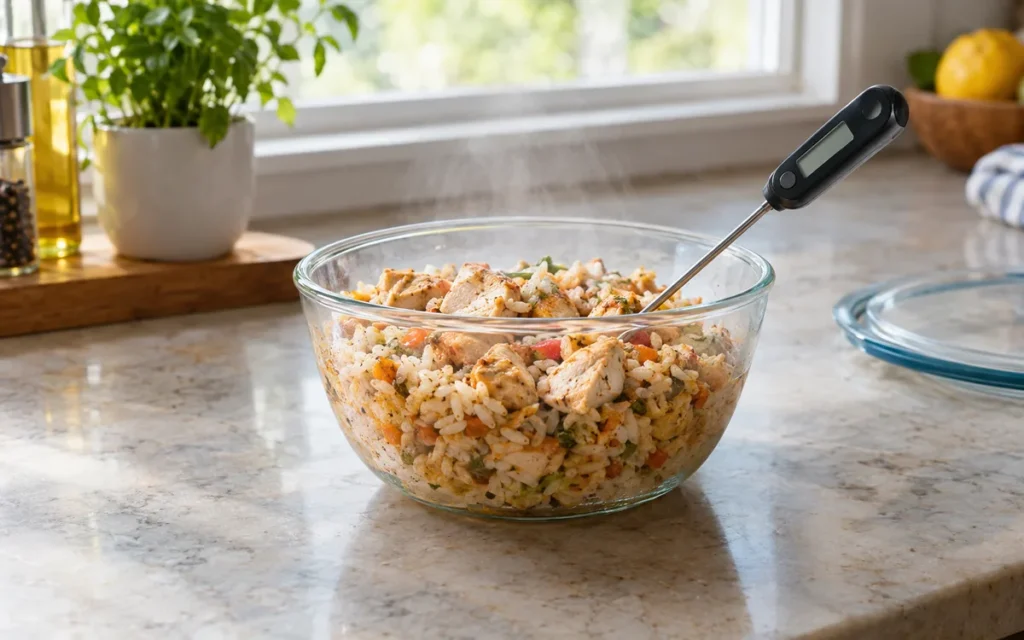
What about cooked rice, quinoa, pasta and beans? They follow the general leftovers rule: 3–4 days in the fridge. They freeze well for a couple of months, and cooked beans hold up even longer. Rice needs extra care. It can carry spores of Bacillus cereus that survive cooking, so spread it on a sheet pan to cool quickly and get it into the fridge within an hour.
Cool it fast: the step most people skip
The biggest meal prep mistake isn’t keeping food too long. It’s cooling it too slowly. A full pot of chili can sit in the danger zone for hours if you put the whole thing in the fridge.
- Divide into shallow containers, no more than about 2 inches (5 cm) deep.
- Cut big pieces down: a whole roast chicken into parts, a roast into slices.
- Don’t wait for it to cool completely. Warm food can go straight into the fridge; that’s what it’s built for. Leave lids cracked until it’s cold, then seal.
- Don’t pack the fridge solid. Cold air needs room to circulate.
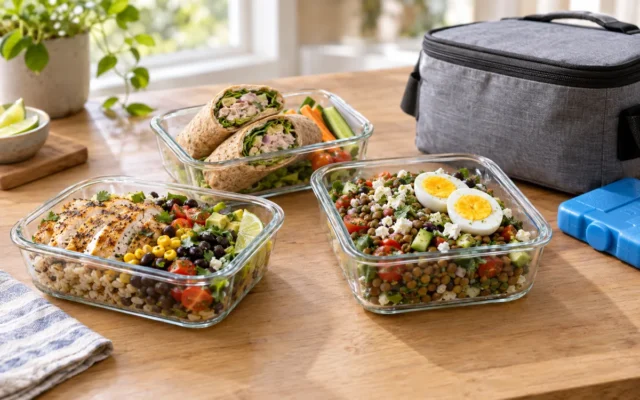
The 2-hour clock keeps ticking once your lunch leaves the house, too. Our guide to high-protein packed lunches covers insulated bags and ice packs.
How to label meal prep containers
Five identical containers in the fridge, and suddenly you can’t tell Sunday’s from Wednesday’s. A strip of masking tape and a permanent marker fix that. Write three things:
- What it is: “Black bean chili,” “Chicken + rice.”
- The date you cooked it, not the date you packed it.
- The use-by date: for the fridge, cook date plus 3 days (for example, “Sun 10 → Wed 13”). For the freezer, the freeze date and the month you should eat it by.
Keep the oldest containers at the front and new ones at the back. And if something has no label and you can’t remember when you made it, toss it.
What freezes well (and what doesn’t)
Great in the freezer: stews, chili, bean soups, meatballs, shredded chicken, cooked ground meat, rice, cooked beans and lentils, egg muffins, pancakes and tomato sauces. That’s why they’re the backbone of a good high-protein meal prep for the week.
Skip the freezer for: leafy salads, raw cucumber and tomato, whole cooked potatoes (they turn grainy), hard-boiled eggs (the whites go rubbery), mayo, and cream- or yogurt-based sauces, which separate. Add those fresh on the day.
Freeze in single portions, press the air out of bags and lay them flat. They freeze faster, thaw faster and stack neatly.
How to thaw safely
- In the fridge: the safest option. Move it from freezer to fridge the night before; a single portion usually thaws in 12–24 hours. Food thawed this way can go back in the freezer if you don’t use it.
- In cold water: sealed bag, submerged in cold water, changed every 30 minutes. Cook or reheat it right away.
- In the microwave: on the defrost setting, then eat or cook it immediately.
Never thaw on the counter. The outside sits in the danger zone while the middle is still frozen.
How to reheat meal prep safely
Reheat all leftovers to 165°F (74°C) in the center. An instant-read thermometer tells you in seconds. Soups, sauces and gravies should come to a rolling boil.
- Microwave: cover the container with a vent, stir or flip halfway through and let it stand for a minute. Microwaves heat unevenly and leave cold spots.
- Skillet or oven: better for keeping chicken and tofu from going rubbery. In the oven, 350°F (175°C), covered with foil.
- Skip the slow cooker for reheating. It takes too long to get food out of the danger zone.
- Reheat only what you’ll eat. Every round of chilling and reheating costs you texture and flavor.
Can you just smell it?
No. The bacteria behind food poisoning, such as Salmonella and Listeria, don’t change how food smells, tastes or looks. Leftovers can smell perfectly fine and still make you sick. The bacteria that do make food smell off are different ones, the spoilage kind. So go by the dates, not your nose, and stick to the old rule: when in doubt, throw it out.
If you’re pregnant, older, cooking for young children or have a weakened immune system, be stricter: eat leftovers within 1–2 days, avoid unpasteurized cheeses and always reheat until steaming hot. Your doctor can tell you if anything else applies to you.
Follow these rules and cooking once for several days is both safe and easy. Need something to cook? Try our vegetarian high-protein meal prep plan or these 15 easy, cheap high-protein recipes, most of which freeze well.
What to remember
- Cooked meal prep: 3–4 days in the fridge at 40°F (4°C) or below, counting from the day you cook.
- Frozen at 0°F (−18°C), food stays safe indefinitely; 2–6 months is about quality.
- Refrigerate within 2 hours, in shallow containers.
- Label every container with what it is, the cook date and a use-by date.
- Reheat to 165°F (74°C) and don’t trust the sniff test.
Sources
Frequently asked questions
How long does meal prep last in the fridge?
Most cooked meals keep 3–4 days at 40°F (4°C) or below, counting from the day you cook. Prep on Sunday and Wednesday is your last fridge day.
How long can meal prep stay in the freezer?
At 0°F (−18°C) food stays safe indefinitely. The usual 2–6 months for cooked meals is about keeping good flavor and texture.
What temperature should I reheat meal prep to?
165°F (74°C) in the center. Bring soups, sauces and gravies to a rolling boil. In the microwave, cover, stir halfway and let it stand for a minute.
Can I tell if leftovers are bad by smelling them?
No. Bacteria such as Salmonella and Listeria don't change how food smells or looks. Go by the dates, and when in doubt, throw it out.
Nutrition values are approximate. This content is informational and does not replace advice from a dietitian or doctor, especially if you have kidney disease or another condition that requires a special diet.